What Do Body Art and Performance Art Have in Common?
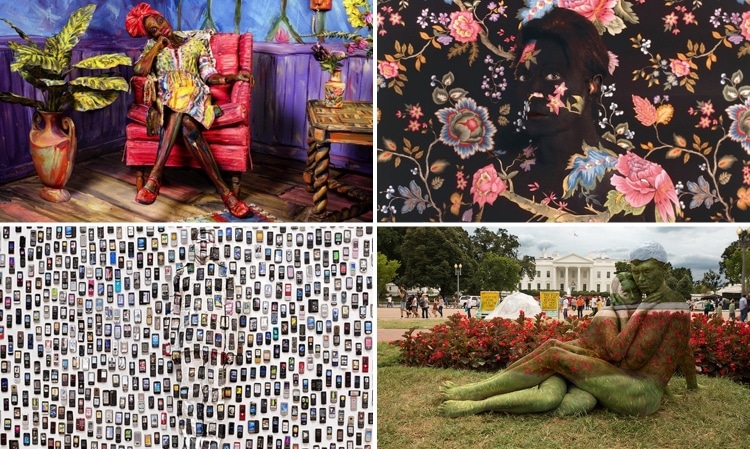
Clockwise from elevation left: Alexa Meade, Cecilia Paredes, Trina Merry, Liu Bolin
As contemporary artists push themselves to explore deeper levels of creativity, information technology'due south not unusual to find interesting art mediums across the standard canvas. Since the 1960s, artists have increasingly explored the use of the human body as a vehicle for expression.
And while body art is often idea of as a type of performance art, using the torso for creative purposes occurs well before Marina Abramovic or Dennis Oppenheim carried out their performances. Tā Moko, the permanent markings of the Maori in New Zealand, are just 1 case of rituals that apply artistic designs with cultural significance.
Today body art includes tattoos, piercings, and trunk alterations, merely perhaps the well-nigh eye-catching are artists who paint the trunk, transforming naked skin into something boggling. Often working to create precise illusions and transformations, artists who paint the body at the highest level are both technically adept and full of fantasy. Creating a connection between art and body is something unique to the art form.
Allow's look at 10 artists whose body art uses peel as a canvass in surprising new ways.
Liu Bolin
Also known every bit "The Invisible Human being," Chinese artist Liu Bolin uses his body to human activity equally a chameleon, seamlessly blending into his surroundings. A look at his creative process shows the incredible endeavor put forth to examine the environment and merge with it. Wearing clothes painted downward to every detail, the optical illusion that Bolin creates is beyond compare.
Bolin'southward motivations for beginning his work are deeply personal. Afterward the government closed the Suojia Village Art Campus, his place of employment, the creative person took a different path. "My resistance to the strength of governments fabricated me experience the life of people with no social condition, no job, no family unit, no income and this was the emotional reason I began my series of works," he says. "In my work, the artist is hiding to restore his strength and to protect himself. I desire my viewers to experience China as I know it, where the concept of artists as human beings was once neglected."
Alexa Meade
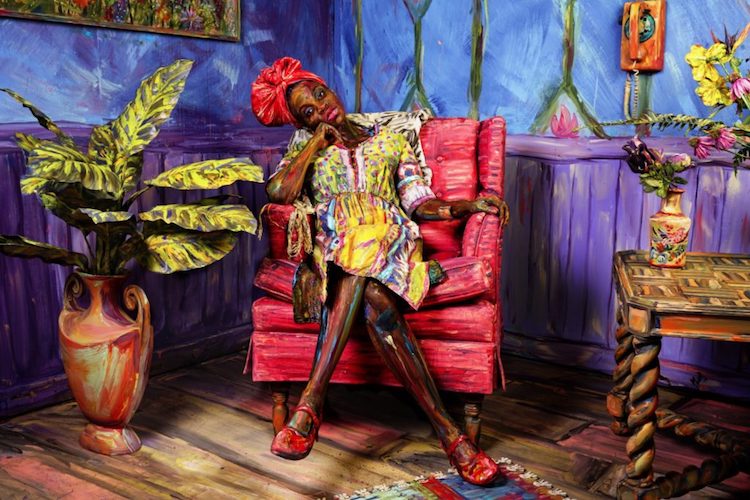
While many artists strive to bring the illusion of iii dimensions to a flat surface, American installation creative person Alexa Meade does the opposite. Past painting her portraits on the human body, she causes them to announced apartment when photographed for a mind-angle illusion that tricks the viewer. Challenging the viewer to blur the lines between reality and fantasy, her acrylic body painting pushes the boundaries of art.
Meade oftentimes places her models in elaborate sets that enhance her "opposite trompe 50'oeil," creating living paintings that are as much about the performance as the final image. Her boundary pushing technique has skyrocketed her to success, with her TED Talk garnering more than 2.5 million views.
"I think the reason I'm not interested in traditional painting in my personal art exercise is that when I used to do it every bit a kid, I could never get annihilation to my liking," Meade shares. "I was very critical and perfectionistic, and I'd overwork it and get frustrated; it wasn't a fun feel. I don't feel positive nigh making things on a flat surface—there'due south this mental block there. But when I create things in three-D, it's completely different. It unleashes a unlike function of my brain altogether and I'm able to create much more than fluidly."
Trina Merry
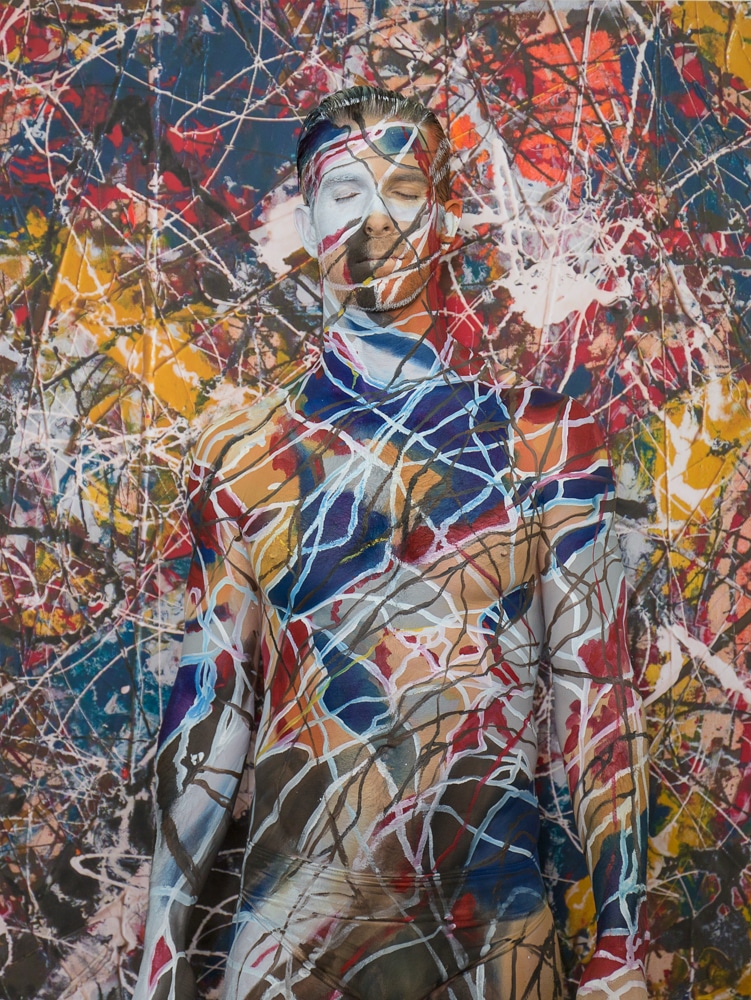
Body paint artist Trina Merry is a principal of blending her models into their surroundings. Subsequently studying with Robert Wilson and Marina Abramovic at the Watermill Center, she took those lessons and applied them to her body art installations. At present, whether camouflaging models effectually the world or creating living sculptures, she is known equally one of the superlative body painting artists in the field.
"I love working with the man body as my surface because my paintings are alive—they have a breath, a center beat, a twinkle in the centre," she shares with us via email. "Bodypaint creates a special connection to a person that other visual art forms accept trouble accomplishing; it's a distinctly human experience."
Cecilia Paredes
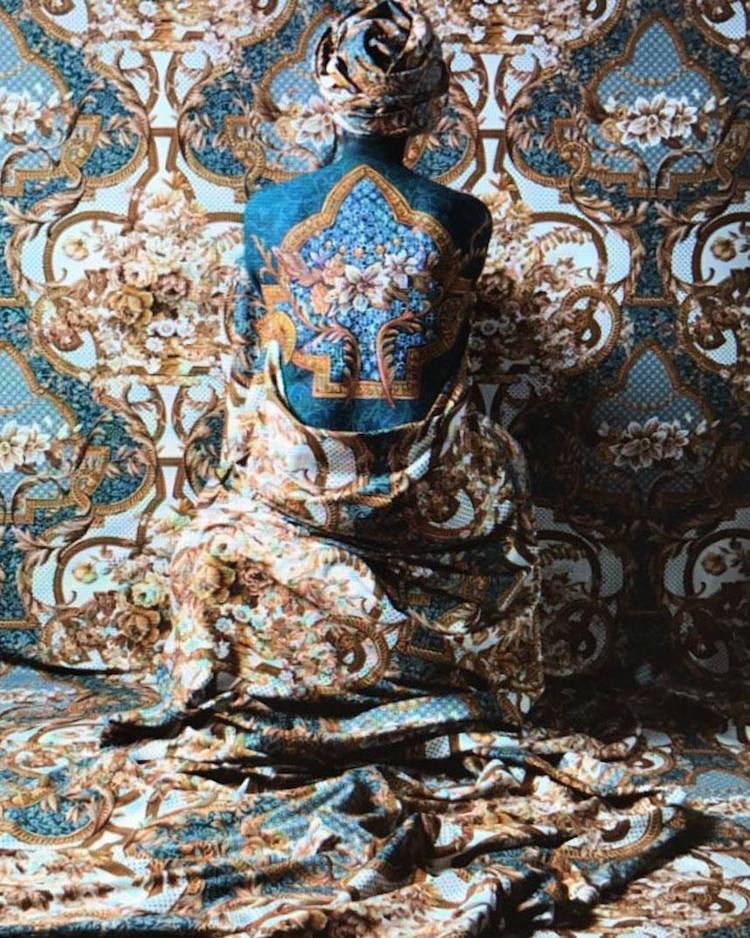
Venezuelan performance artist Cecilia Paredes is known for her photographic performances in which her trunk is concealed against different textures and patterns. Using her own body to perform a type of animal mimicry, it's ironic that her last name, Paredes, is Spanish for the word wall.
Sometimes compared with Liu Bolin, her piece of work differs in that she primarily works in interior spaces, setting up confronting intricately patterned interiors, every bit opposed to blending herself into outdoor environments. Eternally camouflaged, LensCulture writes, "Throughout her work, Paredes succeeds in transforming herself into an expression of her interiority. Her torso, a blank canvas, serves as an empty vessel to reverberate both her surroundings and her feelings."
Johannes Stötter
Influenced by nature, body painter Johannes Stötter has an unparalleled ability to transform i or more bodies into a diverseness of animals. Based in Italy, Stötter has won numerous awards for fine art body painting, based on his incredible technical skill and fantasy. At times, his illusions are and then precise that information technology's just through moving video that ane can decipher the models painted to perfection.
Andy Golub
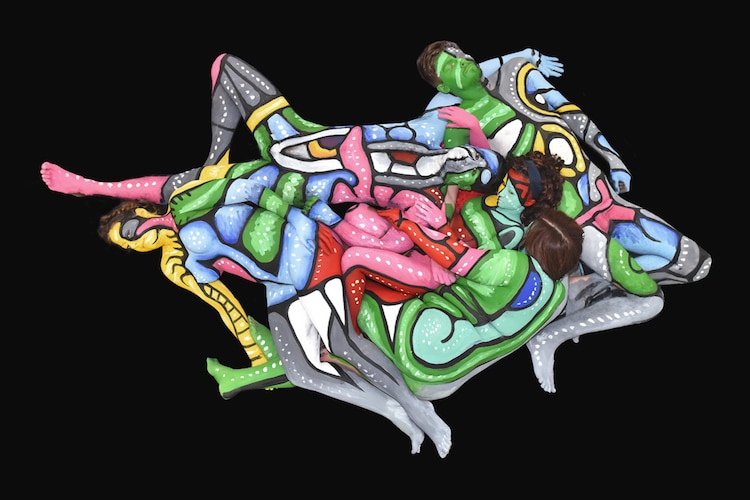
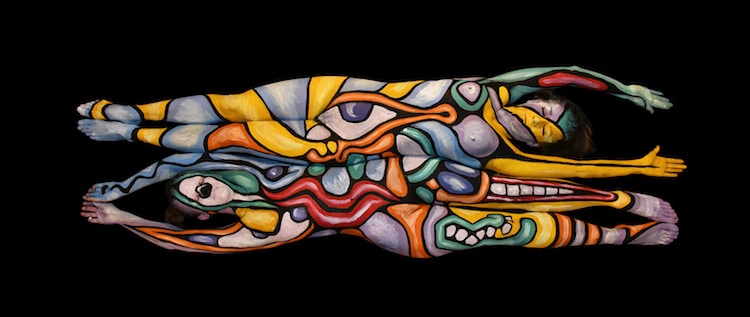
New York-based artist Andy Golub uses models to create his "homo sheet" paintings. These spontaneous, colorful pieces are composed of multiple models who lay on the ground to form a surface for Golub'due south paintings and are then photographed from above.
The resulting works are assuming, graphic pieces where individual elements are obscured to go role of the whole. Golub is also the founder of Bodypainting Solar day, which began in New York City in 2014. His work is as much nearly costless speech as it is most creativity. "We're not using nudity as a grade of exploitation," he shares in regards to Bodypainting Twenty-four hour period. "Information technology'south all near body acceptance, accepting each other equally we are."
Emma Fay
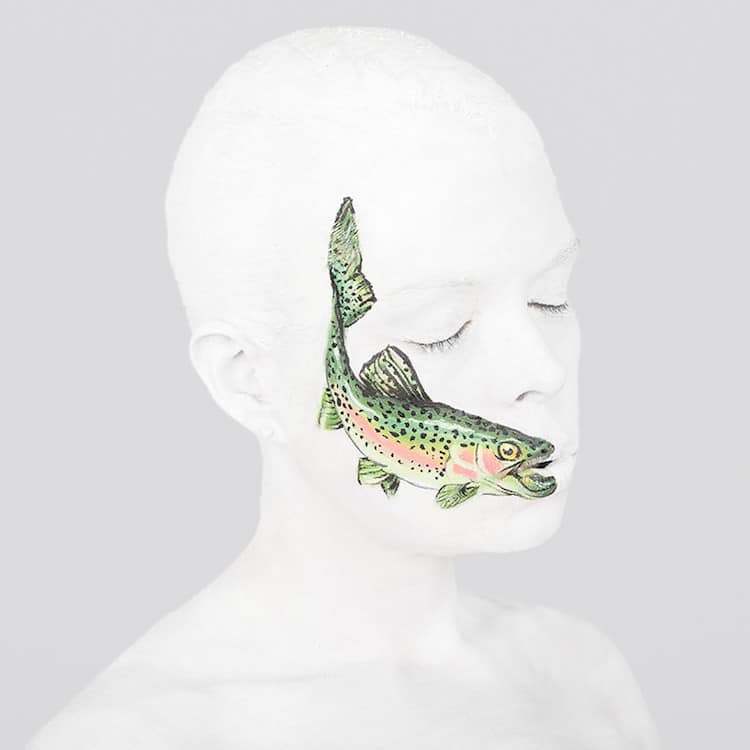
Considering herself a conceptual body artist, Emma Fay'southward work is about challenging visual perceptions. The British artist uses the human body to express a diverseness of social concepts. With her seriesRidiculous, symbols are painted on dissimilar torso parts to highlight our modern obsession with unrealistic and unattainable perfection. From a "trout frown" painted on a stark white face to a breadstuff basket painted on a "muffin summit," her piece of work cleverly, and cuttingly, reminds the states how modern turns of phrase tin can have detrimental effects on our psyche.
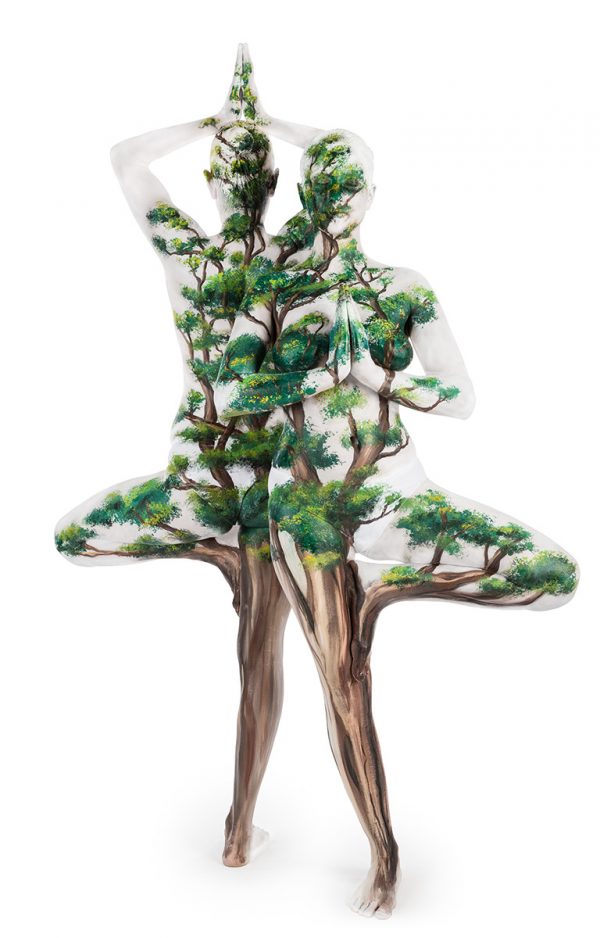
In other work, she combines illusionistic body painting with clever poses to disguise her models every bit animals or mimic outwardly the calming spirit of yoga.
Natalie Fletcher
Artist Natalie Fletcher studied traditional painting, but before long turned to body art to satisfy her creativity. "I was experimenting with unlike canvases and mediums and getting weird with information technology, but I started to get really bored in my studio by myself," she shares. "I realized that photo shoots with models were my favorite function of the piece of work."
Soon this led her to paint models, and she found her calling. "It was phenomenal. Every bit an artist, I had to let go of the ideal of perfection. I used to piece of work for forty plus hours on a painting, but I don't have that time with people, especially if I'm painting outdoors." Known for her incredible ability to create realistic illusions, in 2015 Fletcher traveled across the Us for the projection100 Bodies Beyond America. Over 200 days she painted 140 models—ordinary American citizens of all shapes and sizes. She's since turned the projection into a documentary.
Emma Hack
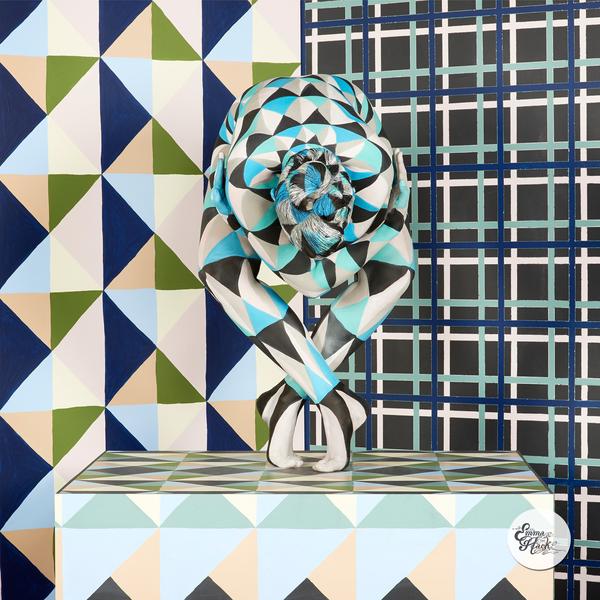
Australian creative person Emma Hack is all-time known for visually merging her models with patterned backgrounds inspired by wall newspaper designer Florence Broadhurst. As opposed to Liu Bolin or Cecilia Paredes, Hack paints models rather than being painted herself. Her work gained international recognition in 2014 after collaborating with Gotye in theSomebody I Used to Know music video.
Gesine Marwedel
Gesine Marwedel is known for her beautiful pare illusions achieved through the use of negative and positive space on the human trunk. The German creative person mainly focuses on natural forms, whether it exist flora and creature or expansive landscapes.
For Marwedel, "torso painting is not but coloring on a living canvass, it is taking up the trunk forms in the motif, painting on and with the trunk. Information technology is the transformation of a human being into a breathing, moving, living piece of work of art."
Guido Daniel
Italian artist Guido Daniele proves that you don't need to make use of the unabridged torso to make a statement. His incredible series of animals painted on hands is a reminder that a nifty centre paired with nifty skill tin can plough out unexpectedly impactful piece of work. Chosen "handimals," the serial is inspired by his beloved of nature.
And while the work is difficult, due to the fact that skin isn't flat or immobile like a canvas, these challenges are what keep information technology interesting for Daniele.

All images via their respective artists.
Related Articles:
Creative person Transforms Herself Into Heed Bending Optical Illusions Without Photoshop
Creative person Creates Hitting Prints of Realistic Portraits Using His Hands as Stamps
xv+ Artists Whose Heed-Bending Optical Illusions Will Brand You Wait Twice
Encounter the Innovative Artists Who Pioneered Performance Art and Elevated Its Importance
Creative person's Optical Illusion Tattoos Look Like They're Hiding Entire Worlds Beneath
Source: https://mymodernmet.com/body-painting-contemporary-body-art/
0 Response to "What Do Body Art and Performance Art Have in Common?"
Post a Comment